
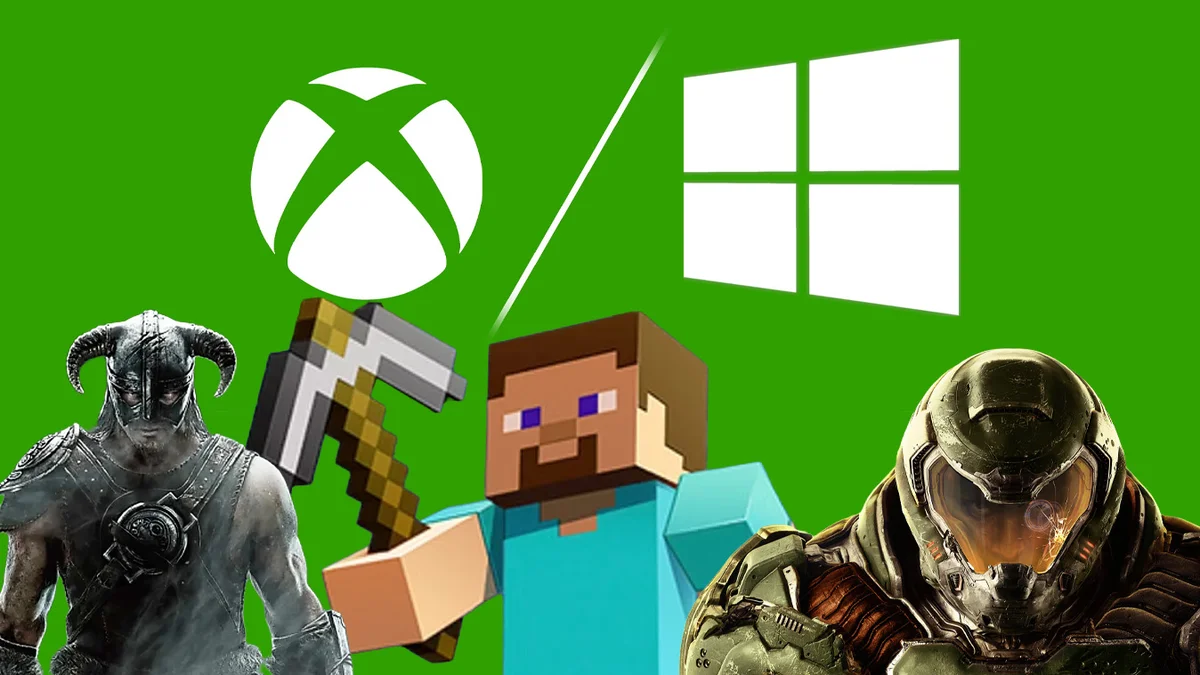
A popular gaming franchise can create two distinct forms of value for a platform owner.
The first is direct revenue from game sales, expansions and related purchases.
The second is indirect: an exclusive game can encourage consumers to buy hardware, subscribe to services and remain within the company's ecosystem.
For Microsoft, these competing priorities are once again becoming central to the discussion surrounding Xbox.
On October 14, Windows Central published details of an Xbox Research questionnaire presenting users with several exclusivity scenarios involving major Microsoft-owned franchises. The publication says it verified screenshots received from a participant.
The survey is not a new official policy, but its questions are relevant to understanding the economic trade-offs Microsoft appears interested in measuring.
Two Business Models With Different Benefits
Publishing games on PlayStation, Nintendo, Xbox and PC creates opportunities to reach customers through multiple storefronts.
That approach is particularly attractive for publishers controlling franchises with global audiences.
Minecraft, for example, has a player base extending far beyond any single console family. Restricting its future availability could therefore carry substantial commercial consequences.
Broad distribution also has another effect: consumers have fewer reasons to purchase an Xbox specifically to access Microsoft games.
The questionnaire approaches that issue directly, asking users how different exclusivity decisions would affect their behavior.
One possible purpose of such research is to understand the balance between software revenue potentially lost on rival consoles and customers potentially gained within the Xbox ecosystem.
That remains an economic interpretation. Microsoft has not published the internal objectives or findings of this study.
Minecraft Presents an Especially Difficult Choice
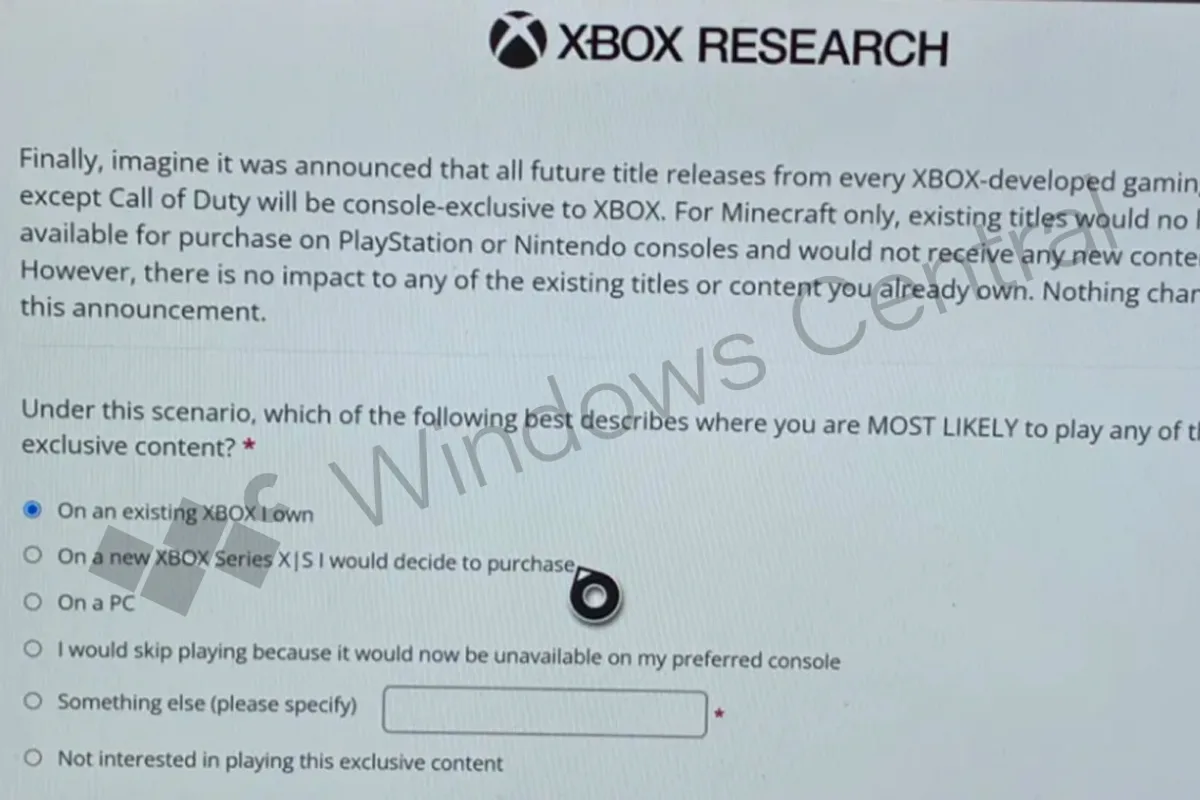
The most restrictive reported scenario concerns Minecraft.
The questionnaire imagines that existing editions would no longer be sold on PlayStation or Nintendo consoles and would stop receiving new content updates.
Existing purchases would remain accessible, while PC availability would be unchanged.
Economically, the proposal could produce conflicting outcomes.
It might encourage consumers who want future Minecraft updates on console to move toward Xbox.
It might also alienate established communities on rival platforms and reduce opportunities for future sales.
The survey asks users to describe their likely reactions. It does not prove that such restrictions would be profitable or that Microsoft intends to introduce them.
Fallout and The Elder Scrolls as Hardware Incentives
Bethesda's franchises present a somewhat different calculation.
Future Fallout and The Elder Scrolls installments could attract committed audiences willing to spend extensive time in their worlds.
Console exclusivity might encourage some of those players to purchase Xbox hardware, particularly if they do not want to play on PC.
However, this depends on numerous variables, including console prices, the devices consumers already own, competing platforms and individual interest in each game.
The questionnaire attempts to explore these decisions through its multiple-choice answers.
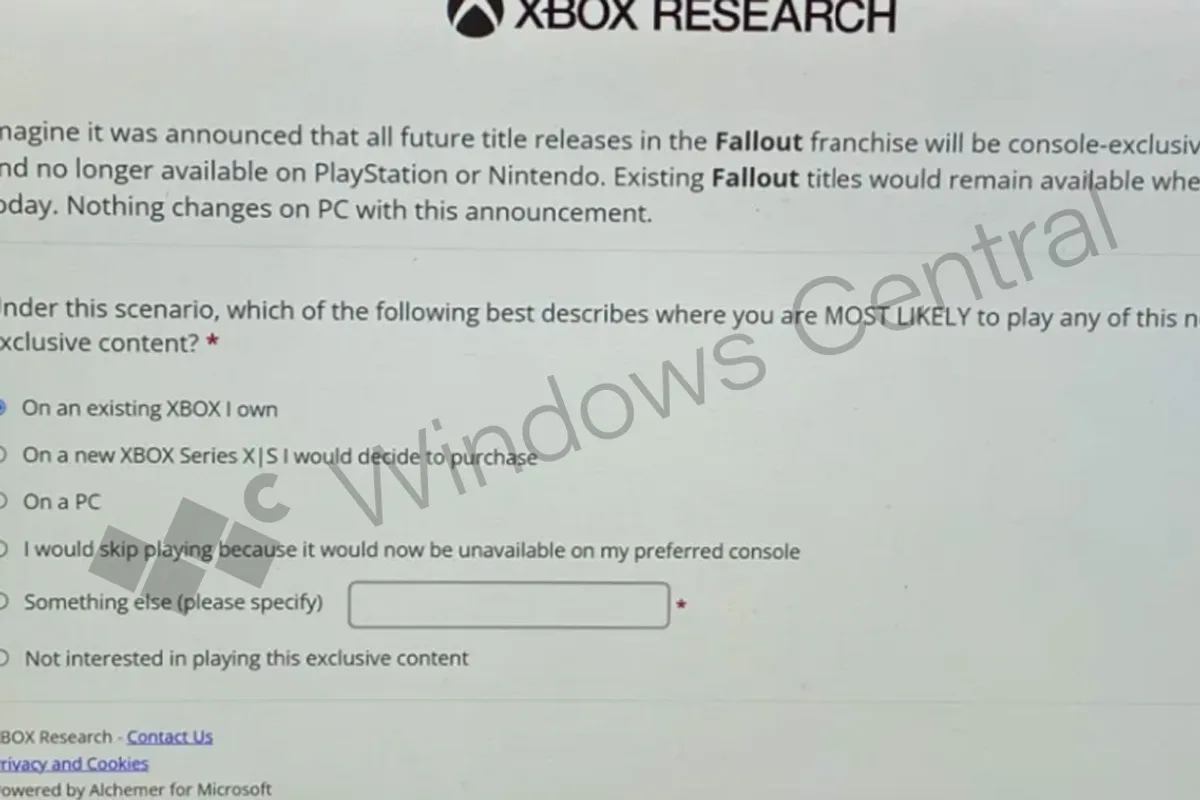
There is still no official confirmation that future Fallout or The Elder Scrolls releases will be limited to Xbox consoles.
Treating a research question as a publishing commitment would confuse an explored possibility with a finalized business decision.
Xbox Has Already Adopted Selective Exclusivity
Microsoft has nevertheless confirmed actual exclusivity decisions in 2026.
During the June 7 Xbox Games Showcase, the company announced that Gears of War: E-Day and Clockwork Revolution would be permanent Xbox console exclusives rather than timed releases.
It also stated that games previously announced for multiple platforms would retain those plans.
This means selected products already serve to differentiate the Xbox ecosystem.
The October survey raises the question of how widely such an approach might eventually be applied.
Microsoft could maintain a selective strategy, reserving some releases for Xbox while distributing others across several platforms.
The questionnaire also explores much more restrictive scenarios, but no comprehensive policy change has been announced.
PC Occupies a Special Position
The reported scenarios share another notable feature: they preserve PC availability.
That distinction explains why console exclusivity should not be confused with total exclusivity.
Microsoft increasingly defines Xbox through services, accounts, game libraries and PC access rather than through a single device beneath the television.
Keeping PC releases while restricting rival console versions could preserve some sales outside dedicated Xbox hardware.
However, this also creates an obvious limitation: customers with sufficiently capable PCs might have no reason to purchase an Xbox console.
The economic value of exclusivity therefore depends partly on how broadly Microsoft defines its own platform ecosystem.
A Survey Is Not a Sales Forecast
The published screenshots offer useful evidence of the scenarios presented to participants.
They do not disclose the study's results, its complete sample size or the exact participant-selection methodology.
They therefore cannot establish how many players would buy an Xbox in response to a particular exclusivity decision.
Nor would it be reasonable to conclude that Microsoft has already selected the most restrictive scenario simply because it was included in the questionnaire.
Market research frequently includes extreme possibilities to identify consumer preferences and resistance to change.
The actual responses and how Microsoft interprets them would matter considerably more than the existence of any individual question.
An Unresolved Strategic Balance
Xbox faces two ambitions that can pull in different directions.
Microsoft wants its franchises to reach large audiences, favoring multiplatform distribution.
But it also operates hardware and subscription businesses whose appeal can depend on having distinctive content.
June's official announcements demonstrate that Microsoft is already willing to reserve selected games for Xbox consoles. October's reported research suggests it may also be measuring consumer reactions to broader restrictions.
No new exclusivity decisions have been established for Minecraft, Fallout, DOOM, Diablo or The Elder Scrolls.
The underlying economic question remains: how many potential multiplatform sales would Microsoft be willing to sacrifice to attract more customers into the Xbox ecosystem?
The survey does not answer that question. It simply shows why the company may consider it worth asking.